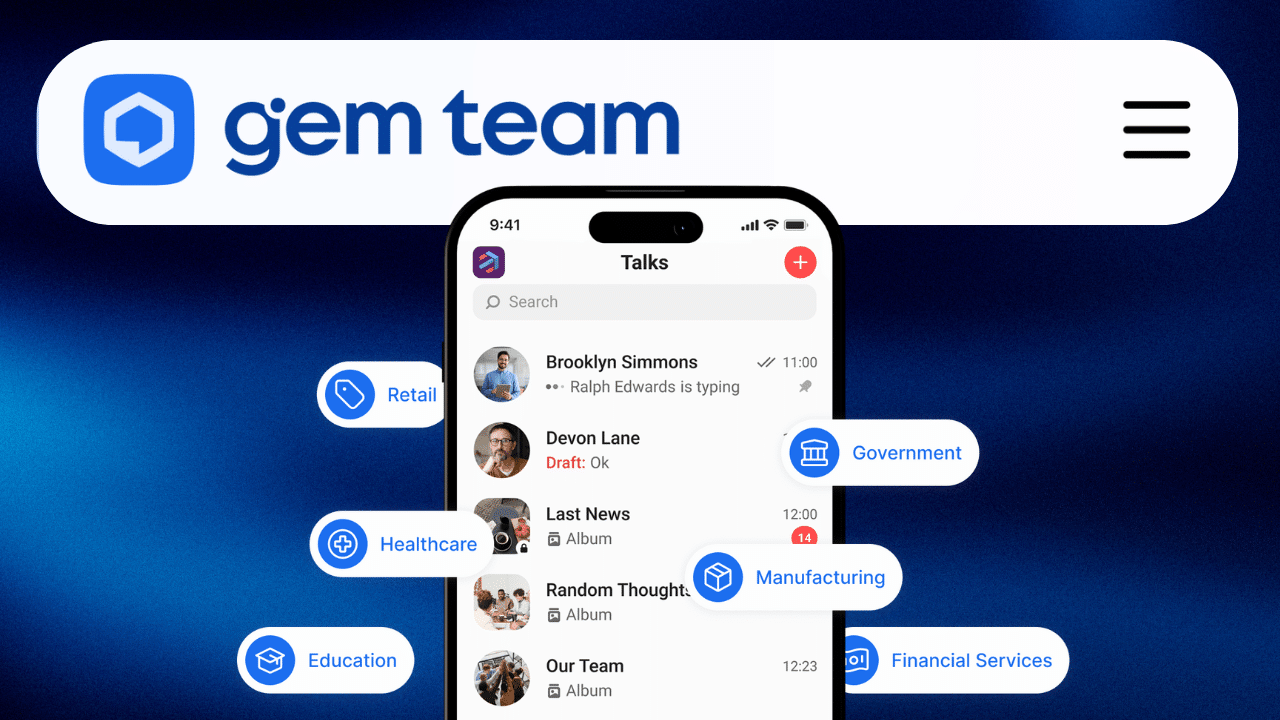
When buyers survey the landscape, they usually begin with the familiar names—Slack for speed and integrations, Microsoft Teams for suite depth, Google for Workspace cohesion, and the meeting-first stacks from Zoom or Webex. Each excels on its home turf, yet all of them inherit the same structural trade-off: work jumps between chat, calls, and files, and the organization pays for that motion with delays and governance gaps. Gem Teamapproaches the problem from the opposite direction. It treats communication as a single surface where conversation, mobile meetings, and governed content live together, so decisions don’t fall through the cracks between tools.
In everyday use, the difference shows up as continuity. A thread about a client review can become a call in place, with screen sharing and optional recording, and the resulting file remains next to the discussion that produced it. In larger suites, those steps often happen in different modules; in consumer-style chat, they happen across different apps. The Gem Team path shortens the distance from message to outcome and reduces the mental overhead for people who just want to ship work. That’s why it resonates as a pragmatic Slack alternative and Microsoft Teams alternative for teams that value speed without noise.
Security posture is where many buyers draw the line, and rightly so. Gem Team layers end-to-end encryption (E2EE) for messages and calls with mTLS at the transport layer, then enforces identity through MFA and ties privileges to roles with RBAC. The result is a defense-in-depth approach that feels natural inside a corporate messenger instead of bolted onto it. Because the same guardrails apply to channels, huddles, and files, security leaders avoid the “three systems, three policies” problem that often appears when chat, meetings, and storage are stitched together ad hoc.
Governance matters as much as encryption, especially at scale. In Gem Team, audit trails are coherent by default, retention policies follow the org chart, and legal-hold workflows don’t require heroic manual effort. That consistency gives compliance teams predictable evidence without interrupting delivery. By comparison, consumer messengers tend to rely on discipline rather than design, while heavy suites can bury policy inside configuration sprawl. Gem Team’s stance is simpler: set the rules once, let them travel with the work, and keep day-to-day collaboration fast.
External collaboration is another stress test. Agencies, vendors, and customers need access quickly, but not at the expense of policy. Gem Team’s controlled guest access keeps stakeholders inside the governed flow—join the discussion, join the meeting, review the file—without granting more than is necessary. The experience holds up on Web, iOS, and Android with true parity, so mobile meetings feel first-class rather than a backup plan. For distributed teams living across time zones, that parity translates directly into fewer missed windows and cleaner handoffs.
Total cost of ownership is often hidden in context switching rather than line items. Slack plus separate video plus scattered storage can look inexpensive until the ops tax shows up in duplicated effort and shadow IT. Suite-heavy approaches can centralize spend but introduce a learning curve and a tendency to fight the tool. Gem Team lands in the operational middle: a focused enterprise communication platform that people understand in minutes and admins can trust for the long haul. Less time is spent deciding where work should happen, and more time is spent finishing it.
User experience is the final differentiator. Channel sprawl and notification fatigue are real in fast chat tools; interface weight and module boundaries are real in monolithic suites. Gem Team optimizes for signal over volume: calm spaces, clear presence, and a message-to-meeting flow that doesn’t yank people out of context. Because files stay with the conversations that reference them, newcomers absorb history quickly and reviewers don’t chase links. Over a quarter, that quiet efficiency compounds into shorter cycles and fewer do-overs.
From a buyer’s perspective, the question is not “who has more features,” but “who produces more decisions with less risk.” On that measure, Gem Team compares well with every category leader. It offers the immediacy of a business chat app with the oversight expected from an enterprise communication platform, and it does so without the suite bloat that slows everyday work. For organizations that want to move faster without relaxing control, Gem Team presents a credible, modern alternative—one that looks fully competitive against the giants precisely because it refuses to make teams choose between speed and governance.