As Google continues to push ads deeper into AI-powered search experiences, advertisers are being forced to rethink long-held assumptions about keyword control. A fresh clarification from Google confirms a key shift: while exact match keywords still can’t serve ads within AI Overviews (AIOs), they also no longer prevent broad match keywords from triggering ads in those placements.
The update may sound subtle, but for advertisers navigating AI Max, mixed match types and keywordless targeting, it removes a major source of confusion — and unlocks reach that may previously have been unintentionally limited.
Ginny Marvin, Google’s Ads Liaison, has been providing clarity on how keyword match types interact with AI Overviews and AI Mode ad placements, following mounting questions from advertisers testing new AI-driven formats.
Why this matters
As ads expand beyond traditional search results and into AI-generated answers, understanding eligibility rules is no longer a “nice to have” — it’s essential.
Many advertisers rely on exact and phrase match keywords as guardrails, assuming they dictate where and how ads appear. But in AI-powered environments, those assumptions can lead to missed opportunities, inaccurate performance analysis and confusion around why certain ads are — or aren’t — serving.
Knowing which keyword types can trigger which placements is now critical to maintaining reach without sacrificing intent.
What Google previously confirmed
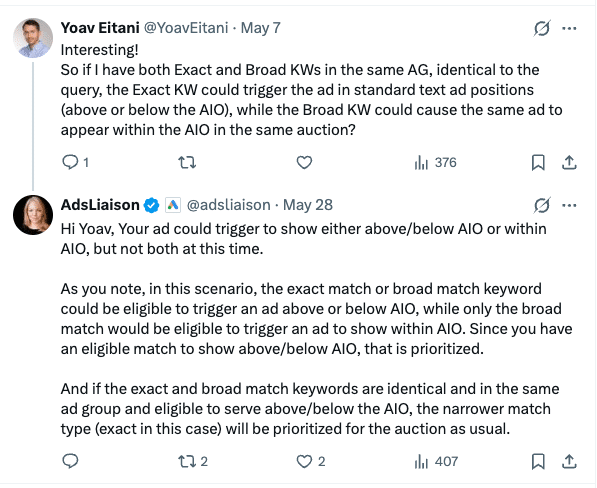
Back in May, responding to questions from Marketing Director Yoav Eitani, Marvin clarified how ad placement works around AI Overviews.
An ad can appear either:
- above or below an AI Overview, or
- within the AI Overview itself
—but not both within the same auction.
“Your ad could trigger to show either above/below AIO or within AIO, but not both at this time.” Marvin confirmed.
At the time, Google also made it clear that:
- Exact and broad match keywords can trigger ads above or below AI Overviews
- Only broad match keywords or keywordless targeting are eligible to trigger ads within AI Overviews
This distinction laid the groundwork — but didn’t fully resolve advertiser concerns around mixed match-type campaigns.
What’s changed — and why it’s important
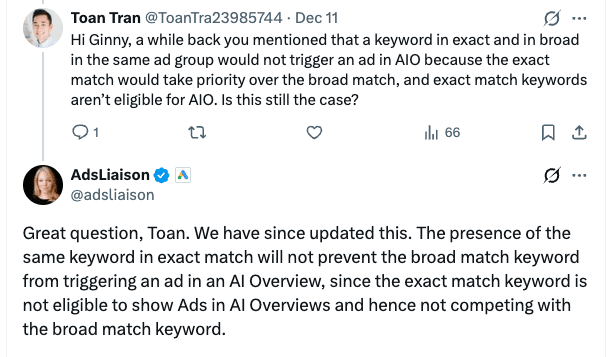
In a more recent exchange with paid search specialist Toan Tran, Marvin clarified a key update to how keyword eligibility works.
Previously, the presence of an exact match keyword could prevent a broad match keyword from serving ads within AI Overviews. That is no longer the case.
“The presence of the same keyword in exact match will not prevent the broad match keyword from triggering an ad in an AI Overview, since the exact match keyword is not eligible to show Ads in AI Overviews and hence not competing with the broad match keyword.” Marvin said.
This is a crucial shift. Because exact and phrase match keywords are not eligible for AI Overview placements, they simply don’t participate in that auction. With no competition between match types, broad match keywords are now free to trigger ads within AIOs — even if the same keyword exists elsewhere in the account as exact match.
What this tells us about Google’s AI strategy
Zooming out, Google is reinforcing a deliberate separation between traditional keyword matching and AI-led intent matching.
AI Overview ads rely less on literal keyword matches and more on Google’s interpretation of user intent and AI-generated context. That’s why eligibility is restricted to broader signals — including broad match and keywordless targeting — which give the system more flexibility to decide relevance.
In other words, AI placements aren’t designed to reward tight keyword control. They’re built to scale intent.
What advertisers should take away
The bottom line remains clear:
- Exact and phrase match keywords won’t show ads in AI Overviews
- But they also won’t block broad match keywords from doing so
For advertisers leaning into AI Max and AIO placements, this reinforces an uncomfortable but unavoidable truth: broad match and keywordless strategies are no longer optional if you want meaningful visibility across Google’s AI-powered surfaces.
The challenge now isn’t whether to use broad match — it’s how to pair it with smart bidding, strong creative and robust measurement, while letting go of the illusion of full keyword-level control.
In the AI era of search, reach is no longer dictated by precision alone — it’s driven by intent, context and trust in the system.